Tuesday, 11 June 2024

Wandering Wellington Street Once Again


Yesterday, during another medical appointment drop-off, I had extra time to drive around downtown to check out various industrial waterfront sites of interest. This pop-up post contains my photographic proceeds. Looking very much like a chalet in the Alps, albeit in the shadow of Rideaucrest, the Doornekamp Queen City Oil Company  is slowly progressing. Look at the pitch on that new roof (top photo).
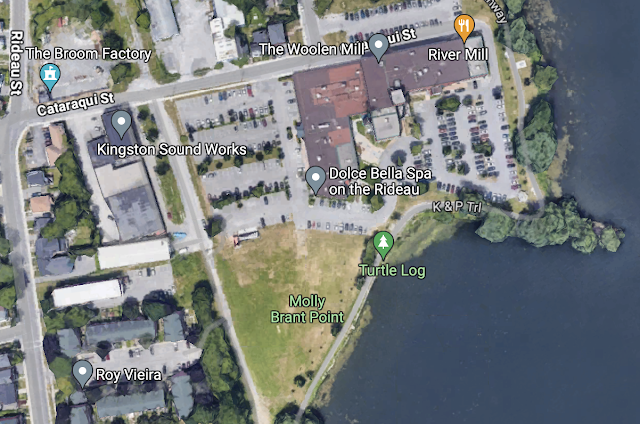
I had never snapped this mural on the south side of the Woolen Mill. Nearby farther south is a fenced off area for a proposed residential development, labelled in this Googlemaps image as Molly Brant Point. Formerly the site of oil and coal depots, and like many locations along Kingston's former industrial waterfront, I'm sure remediation will result:
Inner Harbour view towards the doomed LaSalle Causeway bridge, taken at the Woolen Mill parking lot. A big road crane has arrived to begin disassembly. Many Kingstonians are getting positively sentimental about this soon-to-disappear green metal monster!

These former PUC buildings, on Queen Street, hemmed in by new developments, will probably soon also be toast:
The Merchant:
Former joint trackage location near the Holiday Inn. Those distinctively diagonal building backs belie their former railway relevance.
New development at Queen and Ontario. The Smith-Robinson building is just visible along Ontario Street at left:
You can never go wrong with a Bajus Brewery photo. And I can rarely go past without taking one!
I was on my way to check out MetalCraft Marine, currently land-locked with the inoperable causeway bridge. Captain Matthew Flinders may have circumnavigated the Australia continent, but he can't even navigate his way out of the Inner Harbour until the bridge is removed before reconstruction, now. In the dry dock:
Whale, Terra Australis and sailing ship on the bow. Flinders completed his inshore circumnavigation of that southerly continent at 1803, and died at the age of 40!

Monday, 10 June 2024

1 CSR Freedom of the City - August, 1984

On Friday August 3, 1984 1 Canadian Signal Regiment was granted the Freedom of the City of Kingston. The regiment approached Confederation Park on Ontario Street at 7 p.m. (where we stood - top photo), with bayonets fixed, flags flying and drums beating. Greeted by Deputy Police Chief Wilfred Kealey at the foot of Brock Street, regimental commanding officer Lt-Col J.A. Tappin read the Freedom declaration granted to the regiment in 1975 and 1979 before the parade was allowed to 'enter the city'. Colonel of the Regiment P.H. Sutton took the salute before beating the hilt of his ceremonial sword three times on the doors of City Hall as part of the ancient English ritual. The door swinging open and the regiment was warmly received by Mayor John Gerretsen, who accompanied him on an inspection.
The regiment had been established in Kingston as early as 1958, and was the only Mobile Command (Army) unit in this area. A British exchange officer (above) and one-half of the huge (by today's standards) Drums following the colours:
In the distance, the first half of the FHG Drums leads the parade past the foot of Clarence Street, before they turned right to circle the block.

The Vimy Band trails, performing in front of City Hall before a roll-by of vehicles.
The roll-by included Bombardier-built MLVW's:
Headquarters including despatch riders:
Returning to Barriefield past Empire Life on King Street East:
And the first shall come last:
A Whig-Standard clipping of the Freedom of the City published July 31 (below). A follow-up account by Lyndon Jones was published on August 9. By comparison, last weekend's Freedom for the now-titled Canadian Joint Signal Regiment received zero publicity until being shown on Global Kingston nightly news. Who knew?! Security reasons? Foiling protesters? Whatever the reason, public participation was resultantly scant.
2024-style: Two pipers, not two bands(!) and one drummer made keeping in step difficult.
The regiment again exercised its Freedom of the City in 1989 with 263 members on parade for the unit's 75th anniversary; RMC in 1976; the PWOR in 2013; 2 RCHA was granted the privilege in 1983, 1991 and 1996; the entire Kingston Garrison in 2006. Other units such as HMCS Cataraqui also had poorly-publicized Freedoms in recent years.
The next day, Saturday August 4, static setups of camouflaged regimental signals vehicles were on display for members of the public in City Park:


Active displays. Line trucks and despatch riders (above) and weapons in engineer APC:
Generations from now, decontextualized viewers of this photo of the active firearms display will surmise that our county seat of justice was the subject of a coup by armed soldiers!
Personal anti-tank weapon, FN C2, FN C1, Sterling SMG and pistol (above).
 

Tuesday, 7 May 2024

2024 Heritage Fair - The Kids are Alright

'The Kids are Alright' was a 1979 soundtrack by The Who. It's perhaps a sentiment often expressed by practitioners in any field concerned about the future*. Today, I had the honour of serving as a volunteer citizen judge in the King's Town School (KTS) Heritage Fair - and I can assure you - the future of historical interest and preservation are alright! 
*Meeting with my clutch of fellow judges in the benevolently-named and well-supplied-with-refreshments Judge's Lounge (aka upstairs English classroom at the school) this concern was expressed by one of us. 
Snapping a photo of King's Town School and its similarly-stoned neighbour on Rideau Street (above, with two of my fellow judges walking over just as I was!) we were welcomed and given an introduction to our role as judge, including completing the Judge Interview Assessment Rubric we'd use. With the school subject-themed classrooms (i.e. geography, sports, history, technology) hosting 38 displays by students in grades 5, 7 and 8, we would have two hours to hear presentations, view displays and discuss with the students as many heritage topics as we could in that time! As many as 16 of these displays would proceed to the Kingston Heritage Fair.

My judged presentations included: a student's great-grandfatherly WWII experiences, CFS Shelburne, Paul Anka, a residential school survivor's story, the Avro Arrow, the Canadian Football League, Belgian Immigration to Canada, the history of Canadian currency, Canada and the Great Depression, the Dionne Quintuplets, and Canada in Space. The students' approaches to presentation and display were varied, but those who answered their 'big question' best did so by using unique props, display techniques, bibliography, questioning beyond and placing their topic in national or international context.

I went prepared to learn, and I did learn something during each student's presentation at their display. A recurring theme in their research was what I'd call the un-edited online sources of today and the need to use more than one source. Back in my day (yikes!) we only had books to fall back on, as the Internet was still a gleam in Al Gore's eye. As a teacher's kid, a printed source was usually at hand, and that's what often dictated school projects we did. Frog anatomy! Switzerland! Trains!
Our efforts were well-appreciated by KTS staff, with students presenting judges signed notes of appreciation. (Marc Shaw photos posted to social media - it was great to finally meet this fellow historian as well as Peter Gower I'd previously met).


Friday, 12 April 2024

See Jane Walk! May 3 to 5

A pedestrian panoply in the pantheon of pastoral perusal of Kingston's history awaits, much of it along the Inner Harbour and waterfront. The full schedule is here


Tuesday, 9 April 2024

Tramps, Hoboes & Bums...

 ...was a nickname for the Toronto, Hamilton & Buffalo Railway. To Hell & Back was another! Locally we have the Kick & Push moniker for the Kingston & Pembroke Railway. But those three names in this post title were also applied to a class of men who found it more profitable to beg than to work, throughout the early 20th-Century. 

For various reasons, be they employment, economic, criminal, desperation or just of options, these men 'rode the rods' or 'rode the bumpers'. Steel truss rods were used to stiffen the underframe of freight cars, to enable them to carry heavier loads and keep them cambered upwards. They also provided a horizontal space below a freight car that could be temporarily inhabited.

The recent death of well-known Youtube Hobo Shoestring got me thinking about whether hoboes were ever an issue in Kingston. Yes, they were! And not just during the Great Depression.  (I've already modelled homeless settlements in my modelled era circa 1970.)

KINGSTON PAN-HANDLING EXPERIMENT

In 1933, during the height of the Great Depression, a Whig reporter was sent to various locations to talk with the hoboes and those they attempted to beg money from. He found a man on Arch Street selling bars of soap to buy tobacco. A man on Collingwood Street said he had eaten no food in three days. 

The reporter next went to the CN Outer Station 'Jungle' (the vernacular name for a temporary hobo settlement, often where rides on trains were caught). He found five men waiting for a freight, gathered around one of several campfires burning in the Jungle, though the one that was passing was too fast to jump aboard. The men said they got food from the House of Providence, and provided guidance on how to beg effectively:

  • take off your socks, beg for socks. The proponent received seven pair and $1.
  • have long hair, beg for money for a haircut. This man made $2.25.
  • play up a broken shoulder from falling off a train.
  • claim to be a church person, show your Bible. This man made 25 cents.
  • ask, "Can you spare a nickel for a cup of coffee?", "Can you spare a few cents? I'm starved" or, "Can you spare a few cents toward a bed for the night?
The reporter found Kingstonians not all that generous, though finding punishments for vagrants were less severe than in the big cities. Grocery stores handed out 'odds & ends'. It was best to beg before the target's meal time than after. The reporter then tried out all the recommended methods. His results:
  • one-third of targets told him to go to the police station or Barriefield unemployment camp
  • one-third of targets gave (two pairs of sock, one-half pack of cigarettes, 10 cents)
  • one-third gave nothing.
KINGSTON PAN-HANDLING PRESS ACCOUNTS

I found multiple accounts in Whig clippings, reaching back to 1908.

OCTOBER 2, 1908 - Seven vagrants found in Tait's 40x16-foot hay mow on Montreal Street were forced out with pitchforks by six 'bluecoats' led by Inspector Arniel: "Come out of there, you beggars!" eliciting no tine casualties. Earlier, two men on Montreal Street had been approached by two tough-looking characters demanding money.
  • George Conway was working near Grass Creek, remanded for four days.
  • David Purtell was down by the Outer Station, fined $2 or 15 days.
  • James Ryan dropped off the steamer TORONTO, fined $1 or 10 days.
  • Cornelius Monaghan, the 'daddy' of the party, came to Kingston from Montreal two weeks ago, fined $5 or 1 month.
  • George McKenzie was fined $5 or 1 month.
  • Alfred Marsh was visiting friends on York Street, planning to go back to Toronto, remanded for four days.
APRIL 15, 1908 - Quarrymen working near the then-Grand Trunk Railway Outer Station had their dinner pails taken: food, pails and all. There was a group of hoboes in barns nearby.

APRIL 29, 1910 - Eight hoboes were put behind bars, six receiving terms of ten days to one month. They had 44 cents between them. They were using iodoform and 'court-plaster' bandages to elicit the sympathy of their begging targets:
  • Frank Murphy pleaded guilty to drunkenness and vagrancy when found lying on the tracks at Bailey's Broom Factory.
  • Martin Black was unable to work due to a swollen, inflamed hand. He received three weeks - time to have his hand doctored by the jail physician.
  • Michael Sheridan was selling court plasters, not begging. Sentenced to two weeks.
  • John Tompkins was saucy when arrested by Constable Taylor and Sergeant Nesbitt. He and two companions were found hiding behind a boxcar at the Outer Station.
  • William Curry was working his way from Montreal to Toronto to take a place on the steamer DUNDURN. Ten days.
  • John Rourke was heading for work in Napanee. Twenty days.
  • Louis Siegel showed he was working on the steamer CORNELIUS so was released.
  • Joseph Laponte had a position waiting on steamer HAMILTON. If his story held out, he would be released from his remand.

MAY 20, 1914 - Vagrants James Miller, Henry Dorsey and James McKay arrived at the Outer Station on an eastbound freight train, promptly arrested by Constables Batson, Cotter and Nicholson. They had been working east with a gang of six who continued east, possibly robbers. The men were taken by the constables into the city aboard the Suburban train. They were badly in need of a bath, having encountered the cinders along the way. They were charged with vagrancy, $5 plus costs for each. 

JULY 31, 1920 - GTR foreman A. Deshene, working on an extra gang near the Outer Station, found money and article missing from his boxcar boarding car. Petty thieving had been noted to be increasing, with a corresponding increase in the number of hoboes securing transportation without paying fares.

In 1925, following the murder of JP Calkin at Walsh, Alberta, Canadian Pacific was cracking down on hoboes 'riding the bumpers'. There were more hoboes in Western Canada in the spring preceding seeding, and in the fall, preceding harvest.

In 1931, the increasing number of private automobiles on the road led to more hitchhiking than riding freight trains. Trucks had No Passengers/No Riders signs. Hoboes were often winked at, and not encouraged during the unemployment conditions of the Great Depression. One young man said he had been out of work all summer, had been to the Pacific Coast plus Kingston-Toronto trips on his 'boxcar Pullman'. He noted the boxcar was not half-bad, but there was always the danger of falling under the moving train.

AUGUST 25, 1932 - Two carloads of provincial and city police were went to Kingston Junction (the Outer Station) to root out a dozen men camping on railway property. Get moving or go to jail, they were told.

FEBRUARY 5, 1934 - Thirty hoboes were stealing rides out of Kingston Junction and were ordered out of the then-CN yards.

AUGUST 19, 1935 - Contable Monahan of the RCMP apprehended Percy Robertson, Gordon Shenks and Gordon Thompson - three men riding the rails from St Catharines to Campbellton, NB. Each was assessed $10 plus costs or ten days in jail by Kingston's Magistrate Shea.

In early 1936, a larger number of transients was noted riding the rods, despite cold weather.

JULY 27, 1936 - Belleville Police arrested three men for Kingston, and Kingston reciprocated arresting two men for Belleville. Armand Paquin and Leo Wilson were charged with housebreaking in Belleville, stealing a guitar, binoculars, blanket and clothing (some wet and surmised to be off an outdoor clothesline). Their eastbound freight was met by CN Detective James Graham plus Kingston constables Platz and Murphy. Locked up in Kingston, they were to be taken to Belleville.

OCTOBER 8, 1938 - Reginald Tynes of no fixed address had been riding the rails all summer between Oshawa and Cornwall before stopping in Kingston. CN Constable George Foster arrested him on vagrancy charges and he was remanded four days.

In early 1940, railway police reported fewer men riding the rails. Men were enlisting for World War II, and industries were hiring for war production. "Only the real hard-boiled knights of the road who never work", were still out there, noted a railway policeman. Kingston saw only three dozen men per week, down from 300 men per week not long ago.

Two years later, in September 1942, the number of road-knights was again fewer due to the war. Transients had to register in the National Selective Service program, which halved the number of hoboes due to the prosperity of wartime! When asking for overnight accommodation, a man was asked for his NSS registration card. Police would feed breakfast to very old or very young transients. It was no longer a glamorous life. Some statistics on transient numbers were given. In 1938-39 there were 4-5 per day. By February, 1942 there were only 67 all month. In June, 1942 only 10 sought shelter for the night. That number was 25 in July and 22 in August.
 
It's interesting to note that the accounts centre on the east-west intercity GTR/CN line, not the north-south  K&P/CP trackage. The CP trains would have been much, much shorter therefore much harder to hop and ride undetected!

Though there had long been indigent men (winos) living around the Inner Harbour, many inhabiting boat houses.


Saturday, 6 April 2024

Kingston & Pembroke - the series


For awhile, I've been looking for a website depicting the stations along the Kingston & Pembroke Railway/Canadian Pacific Kingston Subdivision. Eventually, I decided to create my own. Unexpectedly, it grew into a four-post series, going beyond stations to some of the local hinterland line's history and its facilities within Kingston that I've researched, though largely not had room to include on my layout. 

In this post, you'll find links below to all four parts in the series, hosted on my main Canadian Railway blog, Trackside Treasure. The reason for that site hosting the series revolved around railway content more than Kingston content. Regardless, here are the links:

New Embankment Scenery at the Interchange

Can't see the forest for the trees? Well, that's part of the idea. On this part of the layout, there are four parallel tracks: CP lead and siding, CN lead and siding. Usually, two or three of them are full of cars or a standing train. It looks very....congested. So I wanted to break up the scene visually. After all, several sections of the CN and CP waterfront trackage are surrounded by berms, embankments and vegetation. The best example that comes to mind is the former mainline curve between Elliott Avenue east to the Outer Station. I decided to place an embankment between the two CN and the two CP tracks. A recent purchase of a $5 bag of homemade wire-armature trees at the March Napanee Train Sale was a great bargain. Though pressed flat, I managed to "unwind" some of the branches and place them in front of the CN tracks (above) and in front of the CP tracks (below). An HO-scale hobo was quick to set up his shack.
I'm deficient at taking and posting in-progress photos. I am usually too focussed on completing the task rather than stopping in mid-project to take a photo! Here's a much earlier view of the same scene. For years, I had wood-cutting taking place in the 100% flat/boring area in which I made the embankment:
An overhead view of the new embankment, with two CN tracks at left, and two CP tracks at right:

I also planted a pole line. It's amazing how much our eyes 'tune out' such mundane, though prototypical mid-scene things like telegraph poles. I would never attempt wires on them, but they do help make the scene. Using wood makes the addition of trees and poles as easy as drilling a quick hole. It's important, though, not to remove the drill until ready to place the item. In the midst of all that green, the hole quickly 'disappears' from view!
The embankment consists of two few-inch sections of 1x2 pine lumber. I screwed them to the plywood benchwork, adding some humps and bumps with modelling clay. Then I cut and white-glued 'fairy mat', sold in 1 square-foot sections at Michaels for gnome gardens. I call it the poor man's static-grass! Final touches are some limestone chunks and trees, shrubs and ground foam spread around in white glue. Note the usual lack of ballast, perhaps cinders. If I feel keen, I may cut and glue a few limestone outcrops into the embankment.
The CN Hanley Spur section forces have come to take a look.
The berm regularly provides a backdrop for inbound/outbound cars on the CN interchange siding (right) and spurs (left) loosely modelled on the same tracks along Counter Street (CN Queens). Just a place to stash and display cars on the layout. I really like the look of the area now, wishing I had improved the scene sooner!