Monday, 2 May 2022

Modelling the Davis Tannery


Having delved into the Davis Tannery Fonds at the Queen's University Archives (City of Kingston Archives view, 1977 - top photo), I decided to incorporate the tannery on my Hanley Spur HO scale layout. As with most of my other signature structures, I knew two things before I started: that I would have to find the most logical place to place it, and that I would be able to include only a fraction of the prototype structures. 

This decision would mean the end of my Montreal Street scene. It was a prominent part of the layout near the CN Outer Station, but it did not generate any rail traffic! The only structures were Gus' Railway Restaurant, the Provincial Tire garage and a space-filler Texaco gas station. CN Express was located across the CN track. (I decided to incorporate CN Express along with the tannery, though, also adding an extension to the CP Quattrocchi's spur to the Cohen scrap yard I'm relocating.) In fact, the relatively-modern Provincial Tire garage was the only 'modern' structure on the whole layout precluding back-dating operations to the steam era, so I was not sorry to see it go. The old scene:

I removed the street and intervening scenery. I was able to relocate the CN Hanley Spur lead back a little, to leave room for tannery and CN Express structures in the foreground. Preliminary track location before I added the tannery spur at left (below). The back line at bottom marks the former alignment of Montreal Street.
Even though I had thoughts of pushing the tannery location around the curve to the Queens interchange, the problem with that approach is that the tannery spur would not meet the buildings at the correct angle. So, I decided to place the tannery at the former 'left side' and the CN Express at the 'right side' of the newly-available space. IF I had unlimited space, I would consider modelling all of the tannery buildings. However, this flipped insurance map view shows the relative size of my two layout-sized buildings (yellow outlines) to the prototype buildings, and the edge of my layout (red line). The map is flipped to show the prototype spur matching the alignment of mine in HO scale.

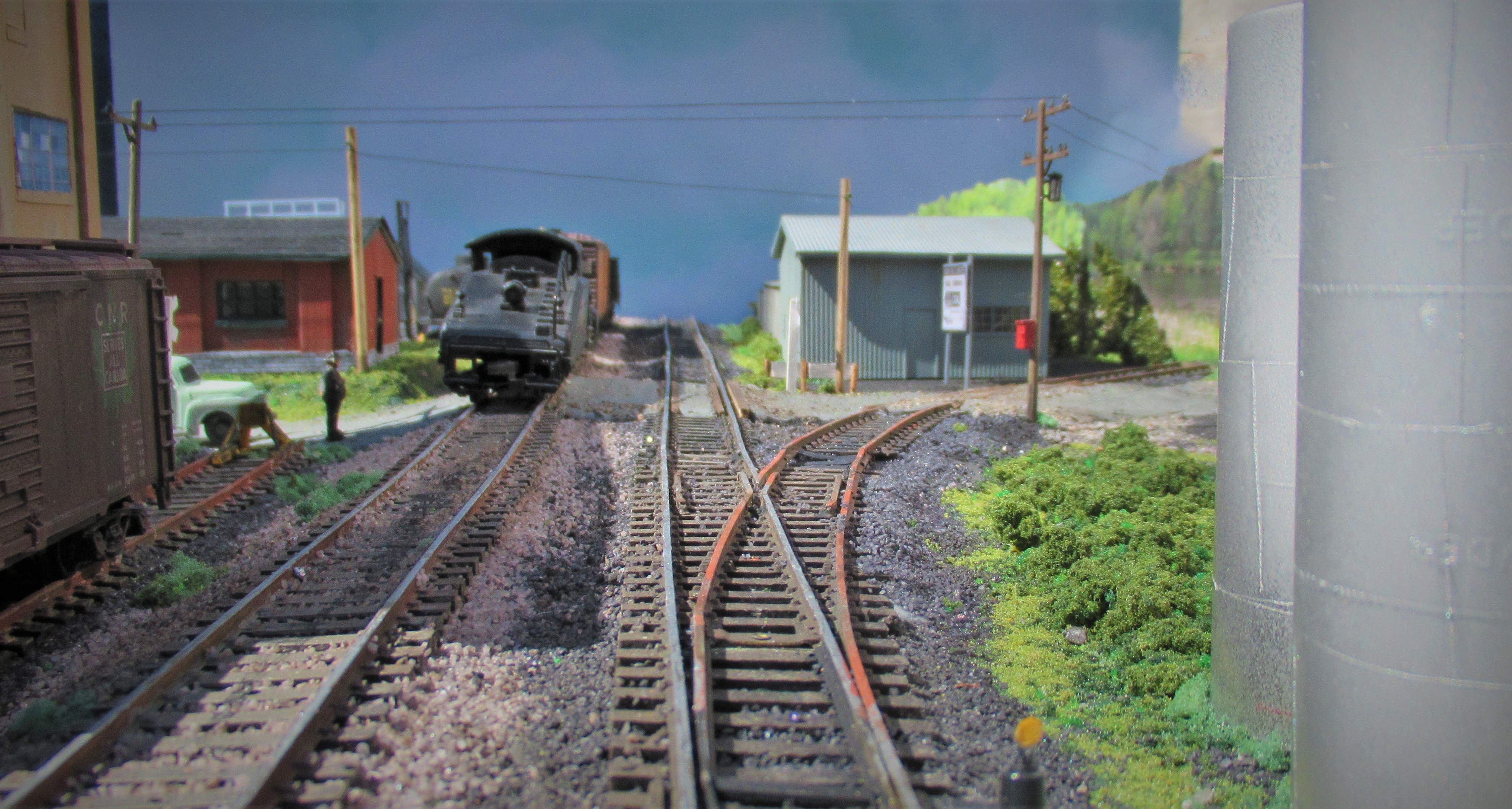
My tannery spur branches off the Hanley Spur at the reverse angle of the prototype, acceptable because it matches the trailing-point orientation of several other spurs just up the line. I installed the spurs at the two new locations. I then traced the available space onto a piece of 11x17-inch paper, so I knew the size of the footprint available for the tannery structures. The prototype spur branches north off the east side of the Hanley Spur. It passes between the tannery buildings and ends there. I did not have the room nor the need to have the spur dead-end; I wanted to see the end of it from the aisle.

Proceeding to construct the structures, I looked at what I had on hand. A Woodland Scenics Cutting's Scissor building (above) I'd purchased for $10 at a train show (tag still attached) would be the main building. I'd long ago vowed not to have structures found on other layouts on my own. So, I needed to customize it to stay true! 
The second half of the tannery buildings, between the tannery spur and the CN lead, would come from a Life-Like Belvedere Hotel kit (at left, above) Both structures were painted white, with existing painted window frames highlighted in white. I also added roofs, and a small addition to the larger building.

Once painted, I realized that to do an 'Art Curren' kitbash, adding lots of details really added to the look of the building. I'm not a tannery designer, and no-one who viewed my layout would be, either.  I also toned down that whitewashed/concrete exterior with some grimy weathering. Even though I have a Walthers smokestack, I don't know if I will add it. This location requires reaching across and I can see myself  inadvertently 'demolishing' the smokestack quite often while switching!
Since the loading doors are prominent, I added some more detail:
Now, all that is needed is scenicking and more details!
An overhead view shows the new Cohen spur in middle of photo. More scrap to follow!
After I began scenery around the tannery buildings, I realized I needed something to visually 'fill in' between the two of them. So, I built an addition to the 'Belvedere' building. Due to the converging tracks, it's angled to make the most of the visual block while minimizing the footprint.
From the wall side, the narrowness of the addition is obvious!
The scene, with scenery including a vehicle shed like the one at the prototype tannery. More trees to follow, because the tannery location as very much like a rural area!
I've found prototype documents to support the loads in and out of the tannery, so now it's time to begin operations here!

412 Bagot Street


This humble structure at 412 Bagot Street, just north of Ordnance Street was once the Partners in Mission Food Bank depot. First operating from the basement of the Church of the Redeemer in 1985, the food bank relocated here in May, 1989. Increased demand for food bank services was the reason for the relocation. This was the former base of the Kingston Regional Ambulance Service. It has a unique false front, cinder-block construction. Increased demand would again lead to relocation to its present location at 140 Hickson Avenue in 2003.

Hanley Spur Diorama

Using some of the signature buildings from my Hanley Spur Layout (National Grocers, Bailey Broom factory, Rosen Fuels and Woolen Mill), I constructed a diorama. The signature scene is Rideau and Cataraqui Streets, where three of the four buildings are extant. I took the diorama outside for some natural-light photography using my iPhone camera and my Canon point-and-shoot camera. In most cases, they are presented in that order when portraying a similar scene. The iPhone really allows for low-angle photography due to the corner-position of its camera lens. In each scene, I'll point out some features I included in the diorama design and construction. 

Looking down Cataraqui Street, perhaps the street is lower and the railway rights-of-way higher than the prototype. Maximum elevation is an extra layer of plywood, molded with clay and papier-mache, then scenicked. I included hydro and telephone lines, these being the last details added - they're virtually invisible when looking and working down at the diorama and therefore prone to accidental removal! The backdrop is a printed bristol-board sky gamely held in position on a windy day by my wife!

I'm pleased to say that this diorama is now on display as part of the 'On The Move - 400 Years of Transportation in Kingston' exhibition at the Pumphouse Museum. The exhibition opened April 22, and will be open until November.

Looking north at the National Grocers spur, from the CP side. The low-level photography readily reveals modelling gaps that the naked eye is less likely to perceive.

Colour views. A peril of outdoor photography is inclusion of trees and the neighbours' houses in the background. Fellow blogger Chris Mears suggested photographing the railway models in front of the prototype structures. Definitely an intriguing idea!


CN 7123 (since renumbered from the incorrect 6012 factory number) on CN's Hanley Spur at left, with CP's differently-ballasted Kingston Subdivision at right, with its spur to Dyeco and tannery branching off at right. Since the track is non-operateing, I had no hesitation in painting the railheads different colours to show their amount of use - silver for in-use, rust-coloured for seldom-used. The Rosen building is one that I had already built - it fit the space I had available.

A boxcar spotted on the Woolen Mill CP spur. Slight diffferences in the angle and photo-editing result in remarkably different results!

Some various iPhone views of the CN switcher, formerly owned by my Dad, positioned with an ice-reefer and an loaded American coal car. All rolling stock, vehicles and buildings are wired to the diorama base. I've kept the scenes free of excess detail/clutter, though I did add several more figures, including a three-man CN crew!


The billboard along Rideau Street is transportation-themed, and one that fits with the steam era. The molding, painted black, on the edge of the diorama is just visible here:
Before renumbering and crewing, the CN switcher is crossing Cataraqui Street. The backrops are paper-printed on foam-core, with the top edge of the backing painted to match the photo, and the backing screwed to the base using brackets.
Final iPhone photo, showing the Cataraqui Street crossing fom the CP side, with my imagined Abramsky's truck patiently waiting.
                                       

CN and CP were given different balasting to give viewers the idea that they are operated by different railways. The Dyeco spur 'disappears' into the backdrop, partly hidden by foliage, the Rosen building and 'ballast' painting on the backdrop.
Back where we started - a slightly suspended point-and-shoot view of Cataraqui Street.

Modern City Taxi, 439 Montreal Street

Modern Taxi dates to 1940. Its current office at 439 Montreal Street is for sale. The Royal Lepage listing shows it as Inner Harbour area! The asking price was $649,000, currently rented at $2,873 per month. Almost one-half acre of property, with direct access from Montreal Street and lower-level access from Bagot Street. Previous owner data-points at this address:

  • Kingston Automatic Transmission, 1970
  • Automatic Transmission Service, 1971
  • King Trans, 1975
  • Pat's Radiator, 1982, 1986
The listing provides some unique exterior and interior views of the building at this familiar location!


Friday, 29 April 2022

Kingston Industrial Employment, 1967

This 1967 listing of Kingston's industrial employment was prepared as part of a booklet for a trade tour organized by the federal government. The report notes that "there is a diversity of industry in Kingston, no one industry is dominant."

Much has been written about Kingston's employment mix, with government institutions: prisons, Canadian Forces base, government department offices; educational institutions: Queen's University Royal Military College and later St. Lawrence College; and this mix of smaller industries in which some come and go, growing and moving away, or being bought out by larger interests. 

At the time of this listing, the largest industries were those producing new 'in demand' products derived from fossile fuels and mining. The smokestack industries, such as they ever were in Kingston, had already died or were dying their slow death. Steam locomotives, small ships and lumber could be sourced more cheaply offshore and imported. High labour costs began to define profit and loss. It was a time when 'we still built things', just not as many of them, and the employment figures for those companies would never recover.

The listing shows the company name, products if shown, and employment:
  • Aluminum Co. of Canada - shapes, sheets -2,170
  • Aluminum Laboratories - 168
  • Anglin, S. Co. Ltd. - woodworking, lumber - 72 
  • Canadian Dredge & Dock Co. Ltd. - ship repairs - 24
  • Canadian Industries Ltd. - Terylene - 1,030
  • Fairbanks Morse (Canada) Ltd. - machinery - 270
  • Davis, A. & Son Lrd. - tanners - 85
  • DuPont Co. of Canada Lrd. - nylon yarn - 2,750
  • DuPont of Canada Research Centre -84
  • Frontenac Floor & Wall Tile Ltd. - Division of United Ceramics Ltd. - 162
  • Gus Marker Block & Tile - concrete blocks - 32
  • Kingston Shipyards Ltd. - ship building - 250
  • Vicom & Co. (Canada) Ltd. - metal stampings - 46
  • Doyles Bakery - 100
  • Weston Bakeries - 185
  • MacLachlan Lumber - 58
Kingston Industrial Commission sign at CN Outer Station, 1966 (top photo - Queen's University Archives).

Thursday, 28 April 2022

CP D-TC Locomotives from CLC

The Canadian Locomotive Co. built 14 Diesel-Torque Converter 44-ton four-axle switchers for Canadian Pacific between 1956 and 1960. Part of their appeal to CP was that being less than 45 tons, the plucky locomotives did not require a locomotive fireman, therefore generating crew cost savings! Prior to their acceptance by CP, the little locomotives were photographed by the company before leaving Kingston. Plant buildings in the background give indications that the 'broken-window syndrome' has taken hold:

CP 20 at Ontario and Gore Streets. Try parking a locomotive on Ontario Street these days! A sign near the limestone wall points the way to Pyke Navigation and Salvage, and the diamond-shaped CLC builder's plates can be seen prominently on the side sill. 
The last five  of the D-TC's were completed in April and May of 1960. CP 23 left the plant on May 30, 1960. These photos show her at the junction of CN's Hanley Spur and the Montreal-Toronto mainline (at left) to be picked up and forwarded to CP, likely in Montreal. These little switchers comprised CP's last order placed with CLC. They were not known for their reliability, and most were retired by the 1970's.

These photos are part of the Canadian Locomotive Co. fonds, Queen's University Archives. CP 10, the first of the class is positioned for its builder's photo on Ontario Street. CP 10 and 11 were completed in November, 1956 and that's likely when these photos were taken. Interestingly, they both returned to the plant to have their trucks replaced. Initially fitted with trucks for a 60-ton, not 44-ton unit, they were overweight by 6,000 pounds. When they re-emerged in February, 1957 there was snow on the ground!
Notice how the 'side-rods' are painted silver. This no doubt comforted the old steam heads - when they saw those side-rods, perhaps they thought these new-fangled bread-boxes were not all that different. This was at the height of first-generation dieselization of both Canadian railways and the demise of steam. The upswept grey paint and the location of builder's plate and F[orward] lettering at right indicate that the front of the unit faces north to the mainline, just like virtually every other locomotive produced here.
That over-intersection streetlight catches my eye! More photos: