Thursday, 17 February 2022

Modelling the Confederation Tour Train

What better way to see Kingston than to hop into a one-axle trailer hauled by an old jeep? That's what the operators of the Confederation Tour Train thought. The prototype likely never operated on the streets along the Inner Harbour, but I suppose there could have been that special request charter by someone modelling the area five decades later. That's me. 
I needed a one-day project and the Tour Train fit the bill. Today, it's a self-propelled tour trolley, but then it was a jeep masquerading as a steam locomotive! The Niagara Choo-Choo was temporarily lettered ‘Retail Merchants of the Kingston Chamber of Commerce’ and was touring downtown Kingston in November, 1966. A jeep hauled two single-axle trailers around downtown and across the causeway to Royal Military College (1967 Queen's University Archives photo - above) for a buck adult fare, and around Queen's University campus - ten miles in an hour. Two undated views of the Jeep-based tour train in front of the Pumphouse Steam Museum:

The original Tour Train in Kingston was a train ‘shape’ cut out of plywood then painted. Passengers’ seats were constructed by local Canadian Penitentiary Service Joyceville Penitentiary prisoners. The power train was upgraded, but the weight of those seats eventually wore out the engine! A 1976 Chevy pickup later provided the motive power in the late-1970's (Whig clipping): 

This build was all scratchbuilding. I had a spare Roco jeep, around which I'd later build the locomotive shape. I cut styrene square stock into benches, on which I placed painted figures, er, tourists! I used some girder pieces from the scrap box, cutting out the cross-braces, and matched their length to the seated figures' trailer platforms.

I cut some styrene for the low trailer sides, painted and blued the girder pieces, added a styrene roof:
The jeep was an exercise in creativity. I cut the side in two pieces, added a roof and coal bunker, a piece of cylindrical shoe-stiffener plastic for the boiler, a stack and headlight, siderods and cylinders all from scrap. Small styrene scraps were the trailer hitches, and trailer tongues from Roco military trailers. I added more styrene pieces for the front and rear low trailer sides. The trailer axles and wheels were from my 'vehicle wheels' scrap box. Still need to add brake lights, though.
I printed the lettering using Microsoft Word. Yes, the jeep and driver are inside there somewhere. Touring Montreal Street, "Can we drive past the Outer Station again??", can just be heard above the roar of the engine!

Tuesday, 15 February 2022

Corvette Scrapped at Kingston

The decommissioned Royal Canadian Navy (RCN) Flower-class corvette HMCS Quesnel was scrapped at Kingston Shipbuilding. There were 12 corvettes built at the shipyard during World War II. This Whig-Standard clipping shows the towing of the corvette named for the British Columbia city was published May 10, 1949 (top photo). It shows the tug Rival bringing the Quesnal [sic] to Kingston from Thorold, where it had been used as a stationary boiler at a pulp mill in the intervening post-war years. These two photos (below) show engine and boiler removal and were taken by George Lilley on June 14, 1949. (Queen's University Archives): 

The boiler is suspended by the sheerleg lakeside crane (above) and the engine appears to be in foreground, right. Side view of the boiler; the corvette at the dock. (below). The raised side of the hull may was the pom-pom anti-aircraft gun platform. Upon viewing these two photos in the arvhives, the shape of the hull had me wondering if this were a corvette, and it was threee years later that the news photo confirmed the date and provided the identity of the unfortunate vessel!


Here's George Lilley's photo as it appeared in the Whig on June 16, captioned:

After World War II, the Canadian War Assets Disposal Corporation was selling 68 decommissioned Royal Canadian Navy convey-escort corvettes at Sorel, QC for a range of prices, averaging $30,000 each. The prices could be higher or lower depending on condition (most heavily-used in North Atlantic service) and bulk purchases. Eighty-eight corvettes were 'de-stored' at Sydney, NS on the way from Halifax to Sorel by October. There were already 14 corvettes at Sorel when the HMC ships Brandon and Sorel were towed there in June, 1945 with more than 65 there by October of that year: In total, 93 Flower-class and 12 Castle-class corvettes were the property of Canada post-war. Sixty were sold to Canadian firms for resale or conversion (24) or scrapping (36, though some like Barrie ended up resold); 24 to United Ship Corp. of New York (for resale, including three to the Chilean navy), and seven to the Venezuelan government.

Many were purchased for scrap and towed to Dominion Foundries (Dofasco) at the other end of Lake Ontario in Hamilton to meet their demise. Just so much scrap metal after taking part in the Battle of the Atlantic, the longest-running battle of the war. The scrapping of five Kingston-built corvettes was announced by C.D. Howe on November 14, 1945: Belleville, Peterborough, Prescott, Smiths Falls and Napanee. The ships' bells were often donated back to their sponsoring communities and/or namesakes. HMCS Frontenac's bell was returned to the city to mark its centenary in 1946. (Photos below - Whig clippings).

Seven corvettes purchased by Dofasco were designated for recycling into sanitary food cans in Hamilton, at the rate of 20,000 cans per hour. These American Can Company cans were then filled and sent to Europe to feed the population, including displaced persons. All seven were expected to produce 62,000,000 cans, enough for a can of meat, vegetables, fruit and milk each day for a year for 43,000 persons. HMCS Brandon was the first, followed by corvettes Forest Hill, Galt, Chilliwack, Quesnel, Dawson and Vancouver. Interestingly, the Dawson would roll and settle on its side in 30 feet of water and Capt. Leo Beaupre of Pyke Salvage said the tug Salvage Prince and barge Enarco were sent from Kingston to Hamilton to refloat her in April, 1946. 

On October 6, Sincennes-McNaughton tug Rival left Kingston for Montreal for a corvette scrap tow.

October 15, 1945 saw the rusty Kingston-built HMCS Napanee, along with HMCS Lunenberg towed to Portsmouth Harbour by the Sincennes-McNaughton tug Graeme Stewart and its 900-foot tow cable (below). The two laid over for the night, waiting on weather. The former plucky escort vessels could be seen to retain their guns, liferafts, and even ration cans rattling around on deck. Each ship had an escort crew of four Sincennes-McNaughton men aboard. Captain J. Blais was in charge of the two, and up to eight corvettes could be handled at once if desired! The Napanee had been paid off July 12, 1945 and was finally broken in Hamilton in 1946.

In early November, 1945 there were at least three corvette scrap tows passing through Kingston. The first, on Friday, November 2 with two corvettes, docked at the Sincennes-McNaughton dock at Portsmouth Harbour for a stopover from Friday to Sunday. A second passed through on the Friday, followed by another up the lake on Monday, Nov. 4.

On November 17, HMCS Kitchener and HMCS Drumheller were being towed by the tugboat Rockdoe when their lines became disengaged. Strong winds and waves pushed the two vessels a mile east, because they had just left Portsmouth Harbour! Both corvettes floated to the Public Utilities Commission dock. The Kitchener was only five feet above the main city water intake !(above) The tugboat Salvage Queen was dispatched, and both tugs wrangled both corvettes successfully - the Rockdoe with Kitchener and the Salvage Queen with Drumheller. (Interestingly, in 1944 another RCN vessel under the command of Commander S. Hill, had dragged its anchor right across the intake pipe, bursting it.) 

Resuming the Rockdoe's tow, the line snapped again near Kingston Penitentiary, with the Kitchener reaching the shore after drifting. The following day, both corvettes were secured at Portsmouth Harbour, awaiting a bigger tug than Rockdoe, which then departed for Montreal, to complete the tow to Hamilton. Also interestingly, the Rockdoe was completed in October, 1945 for war service but instead chartered from the War Assets Corporation to Sincennes-McNaughton for Prescott-Hamilton scrap tows.

On November 22, three weather-beaten corvettes were towed to Portsmouth Harbour. Towed by the tug Guardian, one was left here while the other two were towed on to Hamilton, awaiting another tug.

The scrap tows were somewhat hazardous, with one tug sinking in Quebec and one corvette running aground for the winter in PEI during transit. These corvettes, quickly built at shipyards on Canada's lakes and coasts, and vital for the war effort, were cast away and dismantled mere months after the end of hostilities. Sic Transit Gloria Mundi.

* * *     UPDATES      * * *

In 90 working days, the Shipyards rebuilt the Collingwood-built decommissioned and dismantled corvette Barrie K138 for freight service in Argentina, at a cost of $125,000. Barrie was brought by the tug Helena from Toronto's Don Basin on May 31, 1947, having been sent to Stelco for scrapping initially. 
A progress update sent to the parent Collingwood shipyard in October. The forward accommodation was removed, new accommodations built on the deck midships, new deckhouse and wheelhouse, twin masts, booms and cargo winches, and other work to suit it to its new use. First in the drydock in June (above), then near the sheerlegs in September (below). 
The former corvette was even considered for lengthening 48 feet, and the installation of a General Motors Cleveland 1200 hp marine diesel engine. There are various accounts about whether this happened or not. Renamed the SS Gasestado, she was crewed and sailed for the State Gas Co. of Argentina, from Kingston on November 18, 1947 after 'sea' trials on the Bay of Quinte in October of that year, with the company seal approved on November 13.
More on the SS Gasestado here. Sold to Victory Transport and Salvage of Montreal, she was resold to Gas del Estado to carry gas bottles along the coast of Argentina. Acquired by the Argentine navy as of November 23, 1954 and renamed Capitan Canepa (below), she undertook survey and research work. Rebuilt by AFNE, her bridge and wheelhouse were moved forward and her stack straightened. She was scrapped in 1973.
In December 1950, boilers from two corvettes scrapped in Hamilton were brought by rail to Kingston for installation in Canada Steamship Lines freighters Simcoe and Elgin.

Some online sources, not the least of which is Wikipedia, simply report Quesnel's disposition as scrapped in Hamilton. Checking some printed references did not give much detail other than 'sold for scrapping'. Certainly, Quesnel was in Hamilton, based on the food-can reference, above. Unfortunately, no identification marks are visible in the photos above to conclusively identify her. I did, however, find a somewhat-helpful evidence trail of the Quesnel's final days.

A February 23, 1946 Chicago Tribune article described an agreement between the Tribune's subsidiary Ontario Paper in Thorold, where the paper's newsprint was produced and the adjacent Beaver Wood Fibre plant. Using a 'floating power plant' - a Canadian naval corvette moored in the adjacent Welland Canal - steam as well as existing sulphite pulp would be piped to the Beaver plant. This agreement was mentioned in a year-end speech, both items reported in the Chicago Tribune:

The above clippings certainly place a corvette at the Thorold mill, as mentioned in the Whig photo caption at top. The Brantford Expositor reported the move of the Quesnel to Kingston on May 11, 1949. This report links the Quesnel's use at the pulp mill to its tow to, and scrapping in, Kingston.

Six corvettes stayed in Hamilton well into 1950. The Dwor Metal Company of Port Colborne purchased the steel from the vessels that were to be scrapped at Stelco in Hamilton in July of that year.

An August 7, 1964 story mentions a converted corvette that had been docked at McAllister-Pyke's Portsmouth dock  for some time was to have its engine removed at the Kingston Shipyards
Thanks to Bram Risseeuw for assistance with this post.


Saturday, 12 February 2022

The SA-ga of the SA-Queen

There's a lot going on in this photo that appeared in the Whig on May 6, 1965. Once again, I'm finding the story behind the Queen's University Archives photo, and then some! Local fisherman William Monaghan encountered low water levels while backing down the boat ramp on West Street, but he ran out of ramp. The trailer axle broke when it dropped off the end of the paved portion of the ramp. He also had trouble manoeuvring around the barge SA Queen docked at the city wharf nearby.

Now about that SA Queen, and her cargo at the time, the tugboat Newfie Queen. They had a storied history in Kingston harbour with Pyke Wrecking & Salvage.

In mid-April 1930, the SA Queen headed to Brockville with a spile driver after working on the CPR spile docks north of the LaSalle Causeway.  She was in the Kingston Shipyards drydock on August 30 for shaft repairs. On September 26 of the same year, she headed to Point Anne to save the grounded coal boat Valley Camp.

Tugs SA Queen and Salvage Prince, skippered by Captains Phelix and Grant Pyke, respectively, set out to recover an American 130-foot yacht near Oswego, on October 20, 1931.

When the steamer ferry Wolfe Islander lost her rudder on Apr 16, 1944 the SA Queen headed out from Kingston to Livingston's Point. That's where the ferry had been going in circles, eventually close enough to the dock on the island for a deckhand to throw out a line! Brought to the Kingston Shipbuilding Co. drydock, a new rudder was immediately fabricated.

In late-May 1944, the SA Queen brought the Champion from Gananoque, where it had spent the previous five years. No longer needed after the construction of the Ivy Lea bridge, the oil burner was at Swift's wharf for repairs. Interestingly, here's the Champion at the Canadian Dredge & Dock drydock in a July, 1938 Whig ad: 

The Wolfe Islander was laid-up on December 23, 1955 - the earliest date since the winter of 1929 - due to a broken rudder in the ice. The Newfie Queen and Salvage Prince brought the ferry to the shipyards from Wolfe Island. 'Buck' Mullin's Saucy Sally was pressed into service until ice formed.

In late-October, 1956 the SA Queen and Salvage Prince went to assist the Grey Beaver, loaded with grain for Montreal, aground off Alexandria Bay. Grain was lightered into the barge Hilda.

On February 20, 1958, the SA Queen was in the Kingston Shipbuilding Co. drydock with the Wolfe Islander. The former for repairs from a grounding the previous fall, the latter for its four-year survey.

On August 11, 1958 the SA Queen, with its crew Capt Lyle Dougan, Jack Sudds, Tom Compeau, Ken Eves and cook Mrs McCloskey, helped rescue the cabin cruiser Gypsy from Rochester, NY.

May 18, 1960 saw the diminutive Newfie Queen and the Salvage Queen guiding the laying of the submarine telephone cable to Wolfe Island. The Newfie Queen was based in Brockville at the time.

I need to complete some research:  

  • on the connection between the SA Queen and the ferry Hiawatha, currently a diveable wreck in Oakville, former a Toronto yacht club island ferry
  • did the Salvage Queen become the SA Queen
  • disposition of the Salvage Queen
  • Another salvage vessel named Salvage Queen worked on the West Coast.
  • Vimeo NFB restoration of the Salvage Prince, last of the Great Lakes steam-powered tugs, sold for scrap in 1973


Monday, 7 February 2022

German U-Boat in Kingston Harbour!


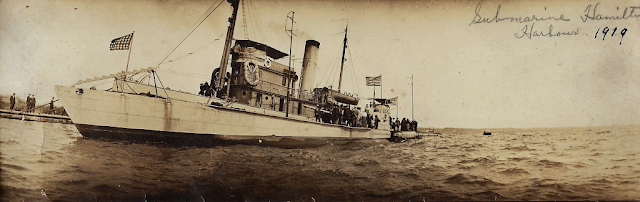
No such provocative headline graced The Daily British Whig on June 2, 1919. Instead, it was, "German U-Boat Visits Kingston" and the use of the word 'visit' seems much more friendly. Regardless, war-weary Kingston still turned out hundreds of onlookers to see the captured prize on its way to Milwaukee, WI (Racine, WI Museum - top photo). The German booty 'boot', one of 160 surrendered to the Allies, was on the Great Lakes as part of a Liberty Bonds drive. One of a class of mine-laying submarines, UC-97 and three others sailed into New York harbour on April 29. Their voyage across the Atlantic took three weeks, making 8 knots. With engine problems, she was taken in tow by the submarine tender USS Bushnell at New York, then the USS Iroquois in Halifax to continue its voyage into the St. Lawrence River. 

The tow stopped at 37 Great Lakes ports, including Alexandria Bay, NY and Kingston. While in Kingston, the vessels stopped over at Swift's Dock, arriving at 10 a.m.. USN Lt-Cmdr. Gibson was welcomed by Kingston's Mayor Newman and at 1 p.m., dined at the Frontenac Club with US and Canadian military and civic personages.

A post-card view in Toronto harbour showing UC-97 docked with USS Iroquois at the Toronto Harbour Commission building: 
Lt.-Cmdr. Lockwood, made a controversial break with tradition while negotiating Canadian river locks, flying an American flag at the fore, not the Union Jack. A postcard view taken in Hamilton:
On display as a tourist attraction at Chicago's Grant Park, a treaty clause called for its destruction and in June, 1921 the USS Kitty Hawk towed the now-plundered sub 20 miles into Lake Michigan where the gunboat USS Wilmette used it for gunnery practice, sinking the sub after scoring 14 4-inch hits. The location of the wreck was found in August, 1992 after searching 140 sq. mi. using side-scan sonar.

Wednesday, 2 February 2022

National Grocers - History


Known as the National Grocers (NG) building, this very solid structure was built in the first quarter of the 20th century (not shown in the 1911 fire insurance map across Cataraqui Street from the Bailey broom factory). Owned by the Weston Corporation from 1936-1976, it shared a joint lead with the Kingston Whig-Standard newsprint warehouse. (Actually, National Grocers was bought by the Loblaw Companies in 1955, and Garfield Weston had gained controlling interest over Loblaw in 1953.)

Nominally located at 12 Cataraqui Street with several additions, it served restaurants, institutions, convenience and corner stores, though not single customers, it was at times described as a cash-and-carry operation.  The Cash-and-carry concept was a departure from old-style grocers in which a clerk handed over items, chosen by a customer, from behind the service counter. The building was built during World War I as a munitions storehouse for the Third Military District. (1951 aerial view - top photo and below, undated - Queen's University Archives, other images are Whig clippings.)

With the National Grocers chain's buying power, economies were found by eliminating overlapping of travelers' territories and distribution networks of smaller wholesalers. NG's operation in Kingston had several predecessor businesses, its lineage stretching back to 1832:
In the 1920's, National Grocers was the largest handler of foodstuffs in Canada, second-largest in North America. Former Mayor W. Craig was once the local manager. His store on Ontario Street (still at that locaion in 1929) merged with 34 other wholesalers as the just-chartered National Grocers chain in August, 1925, and he left his NG branch manager position in 1930, having opened an accountancy office at Brock and Wellington Sts. This 1925 Whig ad showed the volume of business - products shipped in by the carload:
Mr. G.W. Mahood used the building as a cheese warehouse until August 15, 1938, betore National Grocers occupied the building. (Prior to 1939, NG had rented unused space in the Wormwith Piano Factory, later S&R). The NG building's 'edge-of-town', unguarded location was a consistent target for thieves, with reported thefts of cigarettes, candies, chewing gum, melons, sugar, bread, tea and dates on various occasions, taken from the building itself, trucks outside and boxcars on its CN-served spur. In one 1964 incident , three thieves' combined age was only 31! 

The NG building had repeatedly withstood basement flooding from the 1930's into the 1950's during periods of heavy rain. Flood and fire! A June, 1941 fire started in rubbish and spread to the roof of a sugar storage storehouse. Then there's this curious cause of an under-boxcar fire on October 9, 1960:
In December, 1959 a Teamsters' information picket was set up, involving the 16 drivers and warehousemen in Kingston. George Robertson's Wholesale business on Ontario and Johnson Streets was sold to NG in 1966. Jim Stevenson shared this memory, "I worked at National Grocers in the summers when I was at Queen's. From 1963 until 1969 I filled orders in the warehouse for grocery stores, resorts and camps in the area at night that went out on the trucks the next morning. Great physical workout (lifting 100lbs of flour or beans) and got paid too, the first year, the magnificent sum of $1.78 per hour. Shift was 10:30 pm until whenever we were finished the next morning, maybe 8:00, 10:00 or whatever. Good times!" Jim also mentioned sorting potatoes unloaded from boxcars.

A 1970 strike at National Grocers' 11 Ontario branches resulted in a settlement under which drivers were paid $4.25 and warehousemen $4.00 per hour. This circa-1970 image shows an insulated CP insulated boxcar with a CN maple-leaf boxcar on the NG lead, with the outer fence of the Woolen Mill oroperty (Harold's Demolition) at right:
Mike Rose contributed this memory: "I unloaded many a box car full of charcoal or sugar bales at the National Grocers siding. Jack MacMillan, Jack Bearance, Ed Brown - memories of the place and people between 1972 and 1976."

Relocating to 133 Dalton Ave. on ten acres of land bought by the Greenwood Brothers in 1969, that was developed and built on in 1973-74, this new location was more expansive and close to Highway 401. The NG building was listed for sale in this December, 1978 Whig real estate ad:
Used by Harold and Hilda Westendorp as a warehouse for nearby Harold's Demolition, the NG building was the site of an auction held to sell off various stored materials in late-October, 1987. The new owner, George Vosper, purchased the property for $275,000. Vosper hoped to host offices and businesses in his new building, similar to those in the nearby Woolen Mill, another former industrial building.

Meanwhile, National Grocers continued to serve 1,500+ customers from their Dalton Avenue building. Ric Barr purchased the NG building in 2002, evolving into NGB Studios - an artists' colony. Photos from an April, 2019 visit: 
As seen from the Rideau Street side (above) and side facing Woolen Mill with two doors for freight-car unloading (below):
End view from Cataraqui Street:
Built-to-last, this solid structure has done just that!

Sunday, 30 January 2022

Maxwell House Coffee Week, 1948

Coming by the trainload and the truckload! And our city's consigned coffee boxcar is shown! The Whig had two full-page ads on March 11, 1948 advertising Maxwell House coffee. City merchants (above) and from the wider area. (As always, click image for a larger view.)
Watch for am upcoming post on Amherstview's history. I wonder if the bottom-left ad for the Amherst-View Grocery and Tourist Camp is one of the earliest uses of, in this case, 'Amherst-View' and where this campground may have been located. Sounds like it had a view of Amherst Island.


Drones over Downtown, 2022

In their 2021 year-end video, the Doornekamp companies piloted a drone over their Kingston projects. Labelled screenshots show 2021 views and snowy 2022 views. The drone footage not only shows each project, it also gives a unique perspective on the area and context in which each one is located.


Wednesday, 26 January 2022

Millard & Lumb - History

Both men for whom Millard & Lumb (M&L) was named were foremen at the Canadian Locomotive Company. Opened on December 15, 1924 and betting on the new-found process of welding, replacing riveting, the firm served the local marine industry for decades. The day they left CLC, their boss was so skeptical about the future of welding that he gave their new venture six months' future! 
In 1930, M&L welded 7.5 miles of contiguous pipe into the cooling system of the Kingston Curling Club with 2,000+ welds! This 1934 Archives of Ontario image shows M&L through the main entrance of Fort Frontenac:
A major part of M&L's work was commercial boiler repairs. During the Depression, the firm built asphalt plants for a Cleveland firm, thought to have required a railway spur to the plant to load the completed equipment. From the thirties to the fifties, employment was as high as 50. Laid-up ships made winter work for the firm. The Seaway and marine modernization doomed that line of work. 
Two Queen's University Archives photos - undated (above) and 1949 aerial (below):
The nature of its work had changed to steel fabrication for local large customers like Alcan, CFB Kingston, Celanese and Queen's University. Instead of fabrication from the ground up, importing, servicing and providing parts for established product lines like Braun high-capacity washing machines was a major part of M&L's work.
In 1974, a Whig want ad promised potential employees an hourly rate for qualified welders of $4.50 plus benefits. In 1985, the firm employed 25. It was faced with a number of challenges, including installing air purification equipment to improve the work environment for welders and fabricators, and a developer who exerted pressure on the firm to move for Frontenac Village condo construction. Twelve employees, four of whom were office workers and eight of whom were long-term workers in their fifties and sixties, were to end work on November 30, 1988, staying till December 23 to finish contracted work. Then the doors closed. It was the last industrial property to leave the downtown waterfront, in an otherwise commercial-zoned area. The triangular-shaped three-quarters of an acre of land was valued at $750,000.

As of May 1, 1944 Fred, Joseph and Melville Lumb acquired the late William J. Millard's interest in the company. Melville, President, died in 1984 at the age of 76. He was one of the original members of the Kingston Marine Fraternity, a group of local companies that promoted Kingston as a marine centre before the Seaway was completed. Then, J. Gordon Lumb (?Joseph), Frederick's son and Melville's brother, died in 1986 while President. Melville's son Richard was president when the firm closed.

The M&L building still stands at the corner of King Street and Place d'Armes, its prime three-quarter-acre site having sold in 1988 for $750,000, now looking considerably less-industrial. It's surrounded by the Ontario Health Insurance Plan building, arena, Frontenac Village and Fort Frontenac. The 7,800-square foot building  was purchased and developed by Photis Liappas in February, 1989 and redesigned with a second storey.
Classic lettering greeted motorists entering Kingston along Highway 2 via the Causeway in 1967 (top photo).