Saturday, 22 May 2021

Walking the Urban K&P Trail from Binnington Court

After leaving Allan Graphics, having transferred all the files for my upcoming book, Stories on the Waterfront - A Curated Collection of Memories and Photos of Kingston Harbour, we joined the Urban K&P Trail. We went as far west as a wetlands section near Highway 401, approximately 3 km each way. Technically, the Binnington Court trailhead marks the demarcation line between the Urban K&P Trail and the K&P Trail proper. After a short connecting trail running from the end of Binnington to the former CP right-of-way and short bridge (below) near Highway 401, the trail runs straight and level toward Sydenham Road:
It's quite a challenge to get a good photo of the former Knight's Siding. This spur reached the bulk fuel tank farm at Sydenham Road and Highway 401. This time of year, before all the weeds and foliage take over, it's slightly more visible. This view looks north, and the culvert, just visible to the left of the tree at centre, is a giveaway for the embankment of the former spur. Otherwise, who would install a culvert in the middle of the trees?
There are very few vestiges of the CP left. After all, it's been 35 years since the line was finally abandoned, and nature is quick to reassert itself. This pole for a crossing signal relay box is east of Sydenham Road, behind houses on Brass Drive:
Your humble and hydrated (it's important to stay both) blogger with the pole just to the left, and the trail to the right:
Crossing Sydenham Road. In Toronto, it's Mind the Gap; in Kingston, it's Wait for Gap. The traffic does not slow down for ambling trailwalkers! The bulk fuel tank farm is behind the trees at right of photo. There used to be another set of tanks at left, across Sydenham Road, but these are now gone and only the Sydenham Road trailhead parking lot is there.
The informative signage at Sydenham Road (as always, click for larger version):
The original Kingston & Pembroke builders did not concern themselves with ornate culverts. In fact, many of the original, sturdy but cheaply-built stone culverts were only replaced and modernized once CP acquired the line around 1913. The CP upgraded culverts and right-of-way over several years in the 1920's and 1930's. This concrete box culvert, west of Sydenham Road near the 401, is dated 1928:
This one, located closer to Sydenham Road, is still doing its job 94 years later:
My wife, walking partner (and acknowledgee in my books) precedes me as we leave the right-of-way and walk the last few hundred feel on the connecting trail back to Binnington Court. Here, we encounter the only pine trees along this section of the trail, as it backs onto businesses at left (hence the fence). The trail is well used - we encountered cyclists, fellow trailwalkers, families with strollers and even noticed a few horses' hoof marks! But sadly, no iron horses. Only wistfulness would bring back the tolling CPR steam engine bell, the easy lope of the short train heading downhill to the Inner Harbour, and the imagined whoosh of air through open coach windows as southbound passengers prepared to disembark across from City Hall.


Thursday, 20 May 2021

Companion Volume at the Printer!

 
It's time for another trip to the printer! Since December, I've been curating stories, memories and photos of life around Kingston harbour. The main streets and sidestreets, sidings and spurs, docks and piers- all within a block or so of the water.

While my first book Smoke on the Waterfront led readers through the little-known history and seldom-seen locations of waterfront transportation and industrial activity, this companion volume seeks to breathe some life into those dry bones. In order to do so, I've collected interesting reminiscences - from many viewpoints - of what life was like in those same places. 

Its working title is Stories on the Waterfront - A Curated Collection of Memories and Photos of Kingston Harbour. This second book will include even more photographs, thanks to the amazing holdings of the Queen's University Archives.

Watch for further updates as Allan Graphics works their graphic design magic over the next little while!

Tuesday, 18 May 2021

Got the Itch, Again!

Photo selection. Just as last June, when I got the itch to create a new book and Smoke on the Waterfront was published in November, you'll never guess what happened a month later. Yes, in December, I got the itch again, resulting in an as-yet untitled companion volume. The pandemic has been very kind to book creators who still have access to photos and text during lockdown!

The photo in this post shows photo selection and grouping, using a large chalkboard, printed thumbnail photos and lots of post-it notes. 

Stay tuned!


Thursday, 13 May 2021

Thomas McLeod - from the Antarctic to Kingston

Thomas McLeod is buried in Cataraqui Cemetery. George Lilley photographed him in December, 1958. (Queen's Archives photo, top). He made three trips to the Antarctic, receiving at least three medals that he kept in a folde handkerchief, meeting the King at more than one presentation.

  • Able Seaman on Terra Nova 1910 - 1913 on Robert Falcon Scott's voyage, during which Scott fatally failed to return to the ship.
  • Able Seaman on Endurance 1914-1917 on Ernest Shackleton's ill-fated voyage during which the ship was crushed by ice.
  • Able Seaman on Quest 1921 - 1922 on Shackleton's next voyage during which Shackleton suffered a fatal heart attack.

After the Quest expedition, McLeod emigrated to Canada at the invitation of George Vibert Douglas, the expedition’s geologist. He settled in the Kingston area where he fished for a couple of years off Belle Island in the Cataraqui River, before finding employment as a school caretaker at the one-roomed Sunny Plains School and as a watchman at the disused silica mine. This Toronto Telegram despatch was published in the Kingston Daily Whig in January, 1926:

In 1928 he made one further bid to return to his beloved Antarctica. He applied to Admiral Richard Byrd to join his first expedition south. “There is a lot of little things I know”, he wrote, “would be handy when you got south.” His application came too late – the places had been filled – but he was assured that had his application come to hand in time, a man of his experience would have been most welcome. A January 4, 1926 Daily British Whig article noted that no two people in Kingston knew that he was one of the hardy, self-sacrificing hands that carried the flag into new continents.

In 1947 he moved into the Rideaucrest retirement home, where he regaled his fellow residents with tales of his adventures. Most weekends he went to stay with a local family and enjoyed watching their television, particularly the boxing on a Friday night. He kept an active mind and maintained an interest in world affairs. He once told a Canadian reporter, “You know sailing is the finest life there is. If I had mine to live over again that’s what I’d do” and he later resided at the House of Providence. Thomas McLeod passed away on 16th December 1960 and is buried in Cataraqui Cemetery. His gravestone commemorates his achievements in the heroic age of polar exploration.

This intrepid seaman's obituary, in his native Hebrides Islands:

The names of McLeod (misspelled MacLeod), and Shackleton (misspelled Shackelton) are incorrect on the headstone. His date of birth, thought to be around 1873, is also not shown. Interestingly, McLeod's historic marker is only a few feet from my parents' plot, near the intersection of West and Basswood Avenues at the north end of the cemetery. This is how I discovered this interesting bit of Antarctic history in my own, personal exploration of Cataraqui Cemetery.


Monday, 3 May 2021

Not Just Blowing Smoke

It's impossible to say for sure what these smoke columns are emanating from. This 1940's photo of Market Square shows a busy square behind City Hall. But what caught my eye were the two plumes of smoke in the background? One is behind the Fire Hall, above its hose-drying tower.

I don't think it's from a fire - it's not billowing. I don't think it's from a chimney - it's too tall. I think it's actually from two steam engines working the CN and CP tracks along and crossing Ontario Street. I can almost hear the chuff-chuff-chuff!
 

Saturday, 1 May 2021

Two Houses on North Street


North Street arises from water level on the Inner Harbour to Rideau Street. There it takes a slight jag, crossing Rideau Street and running as far west as Montreal Street. River Street peters out at the CP roundhouse and Canadian Dredge & Dock's yard. It was by no means a residential street, and it appears there were only two house on North Street. This post is an attempt to show these two houses. 

One is midway down the street, overlooking the harbour, and I've labelled it "A". The other directly overlooks the CN and CP tracks heading toward City Hall, and I've labelled it "B". I've circled and dated these on aerial photos and fire-insurance maps of the area, below:
Queen's University Library (above), Snapshot Kingston (below)

City directory from 1923:
House "A" is often referred to as The Commandant's House. (Top photo - Queen's University Archives photo captioned April 5, 1964; and below, shared by Marc Shaw, likely a Hazelgrove photo.) The house was built by John Cumming in 1810 (some accounts say 1801), after Captain William Atkinson recived the Crown Patent to the lot in 1789. Providing quarters for officers and during the War of 1812, the property was converted into a Naval Hospital. 

Later known as Cataraqui Cottage, it had stone massive end chimneys and the front, which faced the Great Cataraqui River, featured a verandah.  On an 1827 map, it was shown as the Commandant's Quarters. Richard Bonnycastle, commandant of Fort Henry, may have resided there during the Fort's construction. For much of the 19th-centurry, it was occupied by a military family. Its other nickname was the Colonel McLean house. 

The gable-windowed house sat at a 45-degree angle to the street. As land was reclaimed, the house sat farther away from the river. A Harold Anglin account says that the house was bought from the Kingston & Pembroke Railway by his firm in 1921. The house, one of the oldest buildings in this city, was demolished in 1964. The Leeuwarden condominium building now occupies the site. 
Another photo, posted to Vintage Kingston group on Facebook, shows both houses:
House "B" was of mixed wood and stone construction, facing east-west at the foot of North Street, directly across from the Imperial Oil limestone warehouse.  (Queen's University Archives photo, captioned May 29, 1962) Note the differing juxtaposition of each house with wooden fences and oil tanks nearby.

Thursday, 22 April 2021

Francis MacLachlan's Sail-Training Vessels


This week's Whig-Standard obituaries noted the setting sail of the soul of a man well known in Kingston sailing circles. On Sunday, April 18, 2021, Francis Arnold "Skipper" MacLachlan, loving husband, father, and grandfather, set sail and disappeared over the horizon one last time at the generous age of 95. Francis was born on January 5, 1926 in Kingston, Ontario. Entranced by sailing ships and all things naval, Francis joined the Canadian Navy in late 1945 and thus was too late for battle (to his disappointment). Still, with the Navy he steamed across the Atlantic to do cleanup in England. Returning to Canada in 1946 (aboard the RMS Aquitania) he completed a Mechanical Engineering Degree at Queen's University (1949) and then returned to England, Newcastle-Upon-Tyne, and earned a Degree in Naval Architecture (1951). With a Newcastle colleague and friend, he founded a boat-building firm (while working as a draftsman in the Newcastle shipyards) and designed and built a series of highly competitive racing sailboats. 

Returning to Canada he took a teaching job at Queen's University and continued with boat building. In 1953 the first of three square-rigged sail-training ships designed by Francis, The St. Lawrence II, was launched in Kingston. The St. Lawrence II originally worked in the service of the Sea Cadets but by the early 1960's had moved on to serve a wider community of youth in the Kingston area. Two sister ships Pathfinder (1963) and Playfair (1973) were commissioned by a new Toronto based organization, Toronto Brigantine, to expand youth leadership training out of that end of Lake Ontario. These ships, two still in operation today, have over 150 combined years of operation and have enriched the lives of thousands of people--many of whom acknowledge Francis as an important mentor and inspiration.

Two views of the St. Lawrence II under construction at Kingston Shipyards (above and below - posted to Tall Ships Expeditions Canada Facebook group).

His drawings revealed Playfair to be once again similar to her two sister-ships, St. Lawrence II and Pathfinder.  Maintaining the same (brigantine) rig, the hull was made slightly longer, with a fuller stern and more freeboard, resulting in a vessel of slightly higher displacement of 45 tons. James McConnell and Francis MacLachlan atop the Playfair in a 1973 news clipping:
Dragging the Playfair out into daylight:
James McConnell photo of Playfair's launching. Note Anglin-letter buildings at left:
The St. Lawrence II was constructed at Kingston Shipyards, launched on December 5, 1953. The Pathfinder's keel was laid on Nov. 10, 1962 also at Kingston Shipyards. Launched on May 6, 1963 she was captained by Maurice Smith, noted Kingston marine historian, author and curator emeritus of the Marine Museum of the Great Lakes. The Playfair, with Pathfinder docked astern, was christened by Queen Elizabeth II and Prince Philip during a royal visit to Kingston on June 27, 1973 (two views, below). With the Kingston Shipyards closed three years earlier, Playfair was launched at Canadian Dredge & Dock, sailed to Toronto and her construction completed there. The hull and deck were completed, the interior steel transverse bulkheads were in place, the engine and generator had been installed, and much of the electronic wiring was in place. Total construction costs totalled $230,000.

Photos from the ropeline taken by my Dad, L.C. Gagnon. At this point, the Queen must be at the shoreline:
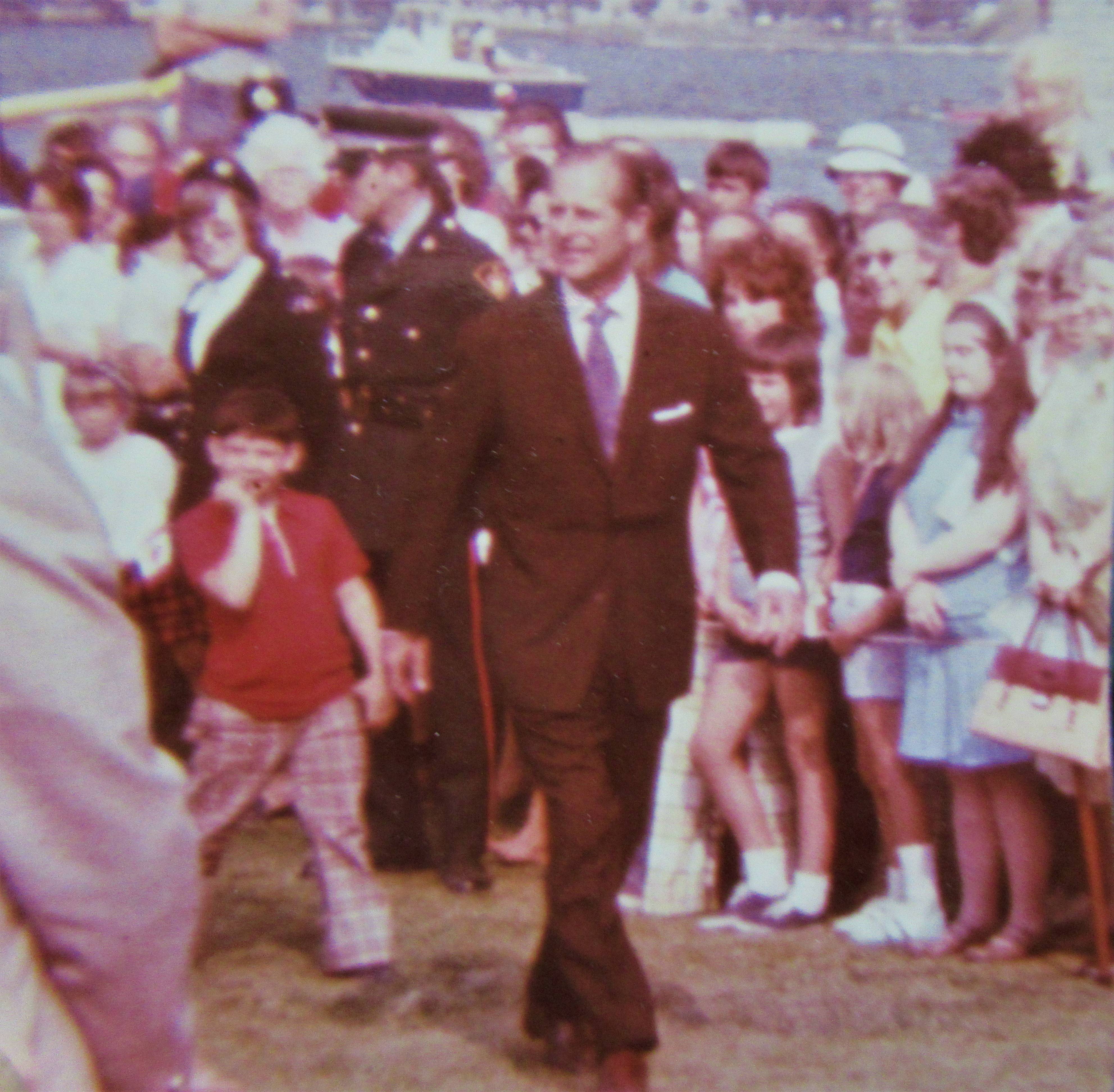
Prince Philip strides along the other side of the ropeline. The Kid with the Loose Tooth has gone rogue:
The Queen stopped to chat to someone who asked her an apparently perplexing question!

Links to a three-part series about MacLachlan and his contemporaries:

Claus Heinecke's painting "Three Small Brigantines":


Monday, 5 April 2021

Corvette Engines to Kingston

In a previous post on the River Street bridge, you'll read about the raising of the bridge during wartime. This not only led to its precarious nature, it also was necessary to bring in the Inglis steam engines for corvettes built at the Kingston Shipbuilding Co. shipyards during World War II. While I haven't seen any under-construction photos like the ones below taken at our shipyards.

In 1940, the clearance height of the bridge was apparently not a problem for trawler (corvette) boilers, this Feb. 13, 1940 Whig article gives their measurements as 16' 9" high and 13' 4" wide:
On July 10, 1942 at a city Board of Works meeting, the request from Kingston Shipbuilding Co. was received and referred to the finance committee. The Cataraqui Street [sic] bridge was to be raised 14 inches:
City Council meeting minutes show that approval was given to raise the bridge to allow the marine engines built by Inglis in Toronto to pass underneath, although that motion was approved on July 16, 1942. The granting of the request by Kingston City Council was published in the July 17, 1942 Whig:
The work was taking place quickly, in August, with costs apportioned to CN for the bridge and city for the approaches to allow boilers to pass underneath:
Also in mid-1942, expansion was taking place at the shipyards for corvette construction. Shear legs adjacent to the lake were being built, with a 100-ton capacity. Their first lift was an 83-ton marine engine. A new 125 x 75-foot machine shop with an overhead electric crane to permit unloading from Ontario Street siding was also being installed. The crane was being installed "to lift the heavy pieces of machinery and steel which come in on the Ontario Street siding and carry them right into the building", according to a June 19, 1942 Whig article. Notice that this engine is even on a depressed-centre flat car to minimize its height:
Four-cylinder, triple-expansion steam engine and two boilers, destined for HMCS Galt alongside at Collingwood Shipyards, December 1940. One of two fire-tube boilers (below) for HMCS The Pas also at Collingwood in December, 1941. Note the comparative size of the shipyard worker! From Corvettes of the Royal Canadian Navy 1939-1945 by Macpherson and Milner.
This cutaway illustraion shows where they were located in the corvette. Engine (red arrow) below engine-room skylight, and fore and aft boilers (yellow arrows) below the funnel.
The 1939-1940 construction program Flower class corvettes were fitted with two Scotch Marine "fire-tube" boilers. These boilers "...held the water inside the huge drum of the boiler and the "fire" was shot through it in tubes which started in the three fireboxes at the bottom and then snaked back and forth through the drum." The large volume of water contained in these boilers provided a large reserve of steam for hunting submarines, but meant that the boilers were slow to raise steam from a cold start. In addition, the Scotch Marine boilers turned out to be relatively unreliable, and their size limited the supply of fuel that could be carried.

Scotch marine boilers were basically large round drums filled with water, with three combustion chambers built into the base. Heat from these oil-fired chambers snaked through the water in a series of pipes until it was vented out the funnel. The steam was drawn off the top of the boiler through high-pressure pipes to the engine. Apart from the ease of construction and operation, the advantage of fire-tube boilers was that they held a large reserve of steam which was useful when a ‘sprint’ was needed to catch a whale—or a submarine. But the large Scotch boilers also limited the size of the fuel storage tanks on either side of the early corvettes and kept their range to approximately 3,500 miles at 12 knots, or 2,500 at their maximum speed of 16 knots.

The 1940-41 construction program ships received "water-tube" boilers instead, in which the main body of the boiler acted as a firebox and water passed through it in banks of tubes. These boilers were superior in most respects to the Scotch Marine boilers that they replaced, and later allowed for more fuel to be carried thus extending the range of the 1941-42 construction program onward.

The 70-ton boilers provided steam to a four-cylinder triple expansion steam engine generating 2,750 horsepower, and providing a top speed of 16 knots. The corvette’s four-cylinder, double-acting vertical triple-expansion engines were old technology, too, perfected in the 1880's. Their great merits were ruggedness and simplicity, and the fact that they were so ubiquitous that finding engineers to run them was not a problem. The engines drew steam from the boilers at up to 200-pounds-per-square-inch pressure and used it to drive the high-pressure cylinder. The steam was then bled off to the intermediate-pressure cylinder before being sent to two large low-pressure cylinders at either end of the engine (hence ‘triple’ expansion with four cylinders). The exhaust steam was routed back into the boilers via a condenser. These engines were remarkably durable. HMCS Sackville’s power plant operated for 40 years!
(above from a variety of online sources, 
including the excellent 'Humble Corvette' series in Legion Magazine.)
This photo (below) shows the bridge with taller timbers and the previous limestone abutments, and the gap between them! Later photos than this Queen's University Archives 1965 photo show the abutments being concrete-encased.
Correspondence from 1940-41 between John Inglis, Collingwood and Kingston shipyards:


Here are some additional advertisements for marine boilers as published in a September 26, 1942 National Post special section on wartime shipbuilding. Inglis was not the only supplier.