Tuesday, 28 April 2020

Modelling the CN Express Shed

In 1965, CN relocated its freight shed from downtown on Wellington Street to the Outer Station property on Montreal Street. The shed was rail-served, with doors and docks for truck loading (yellow arrow, 1978 top photo). I've seen at least one similar shed, built by CN at Morrisburg and still standing. The Kingston shed is now demolished - part of the concrete dock is still visible, but that's all. CN MoW trucks were at the shed decades later:
The building I used has been repurposed over my various layout iterations. Built as an Esso agency, there was a loading dock at the front....
....and a boxcar door on the back. I removed the remnants of the Campbell siding from the roof, adding a new styrene roof, a portion of a Tyco loading dock, and a new rail-served door:
The dock is covered by a heavy steel framework. I've removed the former truck loading dock and I've assembled some leftover pieces from an inexpensive thrift-store town hall kit:
I assembled the framework over the dock. The roof is covered with a paper printed image of rusty corrugated steel. Part of me wanted to leave the framework exposed - so the roof will be removable to show dock operations. I've also added a paper 'concrete foundation' here. Rail-served side:
Truck-loading side:
A word about scale and placement. The prototype shed is well over a hundred feet in length, not counting the dock. My available space is less than that, including the dock! I want to leave room for truck access. Also, the prototype shed's spur approaches from the opposite side of the building. As I've found with my National Grocers building, having the spur on the far side of the building makes the freight cars less visible and less interesting! So, practising selective selectivism, I placed the shed on an existing spur, leaving the cars visible.
Imagine it's a hundred feet long! I added some dock details, shown here with the roof off:
A view of the other end, with shed access and stairs. CN baggage cars were spotted here for extended periods, providing extra storage. Initially, shipments arrived by rail, but in later decades, by transport truck for transfer and delivery by CN Express trucks.
Trackside views (below). Operationally, I'd originally conceived this spur as the Chown Hardware lumber shed (watch for an upcoming post). But I already have two consignees that receive lumber, so I didn't need another place to spot lumber cars. Instead, CN boxcars, baggage boxcars, baggage cars and insulated cars and occasional refrigerator cars. Bringing in cars of express shipments, the cars are often redirected to the downtown freight shed to be loaded and sent off the layout. (Is that weird, sending cars between two sheds when only one was in existence at a time? Hmmm...) The prototype had a large CN-Express-Freight-Kingston-CN sign on it.

All that's currently left of the prototype - the concrete dock being engulfed by vegetation - September, 2019!

Prototype cargo truck box:
And for some time, a track machine donated to the Canadian Institute of Guided Ground Transport (CIGGT) was stored behind the shed with MoW cars - online auction site photo: 

Thursday, 23 April 2020

Modelling C. E. MacPherson

C.E. McPherson, a steel manufacturing operation began business in 1913 on the west side of Rideau Street, south of the intersection with Montreal Street. Currently operating as a division of Conrex Steel, they manufacture head shields for pressure vessels and tanks. CP crossed Rideau Street to reach the plant, at bottom centre of this 1950's aerial photo:
An 'early-Photoshop' relettered ground-level view of the MacPherson building when it was operated by McKelvey & Birch, a local hardware firm:

A major windstorm struck downtown Kingston in early 1950, peeling off the roof of MacPherson. This interior view (above) shows the roofless plant being inspected, with head shields on the shop floor, an overhead travelling crane, and a power shaft providing belt-driven power to the various machines in use. This vintage building disappeared sometime between 1998 and 2004, based on the city's Snapshot Kingston website. Comparative views 45 years apart:
In model form, I'm using the Walthers/POLA Cornerstone American Millwork structure as a basis for my model. This was a $12 train-show find! This structure fits the space available, and I'm going to mainly modify the roofline to represent MacPherson.
The Before photo...notice the central, short clerestory on the kit as built:
Ideally, I would have increased the footprint of this building, making the two outer 'wings' wider - if I had space! I decided to keep the original intact, removing the old clerestory, and preparing to add a new, full-length one made of styrene:
The clerestory is added, with a hole for some end-windows. I found some suitable styrene from another kit for the clerestory roof. It included skylight windows:
 Another roof view:
Instead of cutting holes and adding windows under the clerestory, I simply glued some printed images of windows on paper. I still wasn't happy with those end windows:
I painted the structure a lighter grey and added three paper windows to the end. The prototype included several smokestacks and a couple of end smokestacks:
There was some painted white lettering on a black background on the end of the building, between the three upper windows and the main-storey windows:
My photos of two small photos from Gordon Smithson's At the Bend in the Road - Kingston book  This second photo shows the lettering:
The After photo - I added three windows to the end, also gluing the hand-painted sign on the end, largely imagined from the above two prototype photos. Just some final scenicking remains to be done.

Friday, 10 April 2020

Modelling the Woolen Mill

The Woolen Mill on Cataraqui Street remains a well-known Kingston building, largely because it has always been owned, had tenants, not allowed to fall into disrepair, and eventually extensively renovated. As an anchor scene at the end of my layout's Cataraqui Street, so far it's been a placeholder. But the time has come to renovate this structural flat!

Adding a spur off the CP, albeit entering plant property from timetable-south rather than the prototype's timetable-north based on my track layout, makes the Woolen Mill an industry my Hanley Spur layout can serve. The Woolen Mill has a good history page on its website, including the following two pre-redevelopment photos. This office area would later become the home of the Kingston Whig-Standard newspaper:


Based on the fire insurance map below, the part of the mill in the foreground (above) would have been the cotton warehouse, separated by a breezeway from the cloth room, in the background. Note the shipping platform in yellow, and access door to the interior. This would appear to be where freight cars were spotted. I'm still figuring out what was shipped and what was received. Currently, I ship garments out in CP boxcars.
The flat started out with two sections of Revell enginehouse walls stuck together, backed by a Detail Associates backrop and a stand-in spindly stack salvaged from a brewery:
I added a printed backdrop of a photo of the Woolen Mill I took from the NGB Studio building. I also acquired a cast Sylvan Scale Models square smokestack from fellow ARK member Bob Farquhar which I painted and added along the backdrop. But those roundhouse arches, and windows made from needlepoint plastic canvas! They had to go:
As of April 9, I covered the arches with styrene brick sheet. I also added a new warehouse area, replacing the earlier enginehouse wall, using a brick wall in my scrapbox, adding some window and door openings reminiscent of the prototype. Windows were assembled, also from spares in the scrapbox. I re-did the painting job I'd done on the brick. First I painted it all a cream colour to represent the mortar. Then I dry-brushed three shades of red-brown to paint the slightly-raised bricks and temporarily placed the segments together:
I removed the scenery, added new end walls, rooftop details, a permanent roof including an opening for the smokestack, and divisions between the cloth room and warehouse, where CP boxcars are spotted. I painted the rails and added some more fencing, reminiscent of the hoarding that once encircled this area on the prototype. Additional trees -  printed background also added:
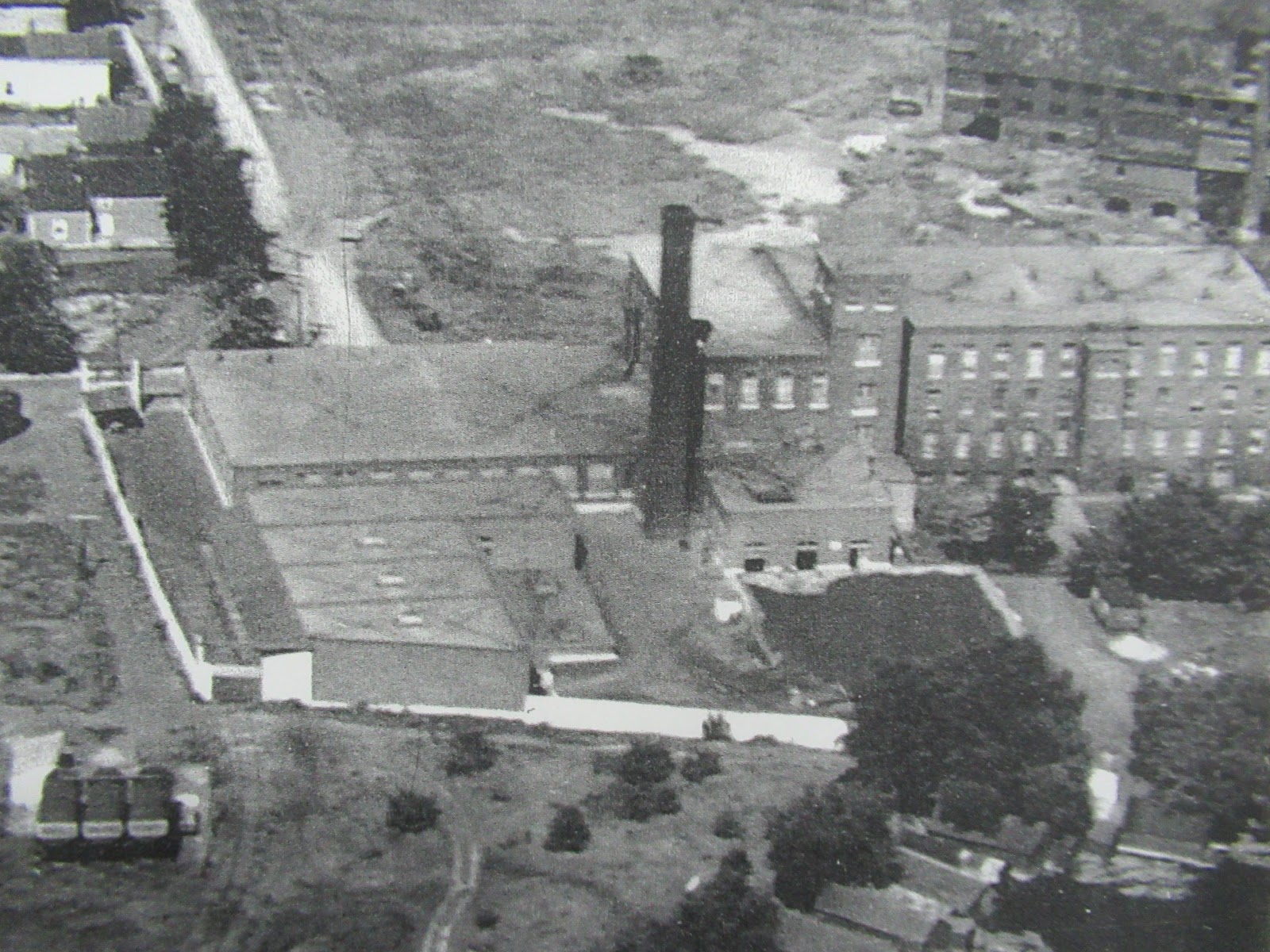
Aerial photo showing the area I'm modelling at left. Notice the white hoarding, with an opening for the spur:
A view from the warehouse end:

Sunday, 5 April 2020

Billboards

Kingston arterial streets like Montreal Street and outer Division Street were excellent places for advertising agencies to place billboards. Fill in those vacant lots!

There are several commercially-available billboard kits, and perhaps some of them have changeable signs. But they'll be generic and in some cases, American prototypes. Of course, I'd like to have believable 'Canadian' prototypes. More importantly, just like real billboards, their value is in their constantly-changing messages. And my perpetually short attention span quickly tires of the same ol' billboard message all the time.
I'd tried various ways of changing paper billboards, like glue, tape, and magnets. The method I'm using now is a styrene billboard on posts, one post with an extension to allow the billboard to fit into a hole drilled in the layout itself. I attach two or three strips cut from 4x6-inch Adhesive Magnetic Sheets, available at Staples of your local dollar store (bottom row in photo below):
For the changeable sign, I print out various billboards (various images scanned or found online, sometimes with local messages added in Microsoft Paint or hand-lettered), then use a tape-runner to adhere the sign onto a piece of thin styrene for stability (top left in above photo). Then I attach two or three analogous strips cut from the magnetic sheets to the back (top right in above photo). This is what holds the billboard in place.
 Not all billboards are created equal, and I have two different sizes available. 
There were even large billboards in Kingston's (now) Hub area, shown in this archival photo from 1952 - billboard for local manufacturer Monarch Batteries:

Thursday, 2 April 2020

Rosen Fuels signs and modelling

"Don't wait until you're half frozen - Buy your fuel from Harry Rosen" was a slogan commonly seen on advertising and fuel trucks in Kingston. I recently found some very interesting material that seems to have been part of a commemoration not only of Rosen Fuels but also printing newspaper ads? A cornucopia of images:
I've needed a sign directing customers to Rosen from Cataraqui Street to fill a bit of a vacant space on the layout. I liked the Self-Serve Coal sign and made my own version using Microsoft Paint:
Now in place:


I hope to model some local fuel trucks. This is a fine example of a Rosen truck (above). The view from Cataraqui Street:
Rosen trucks were even seen on the Wolfe Islander ferry!
1951 Rosen Fuel Supply ad: